
A guide for readers, students or book bloggers

Ever finished a book and felt like shouting your thoughts to the world?
That’s where a book review comes in.
Book reviews are powerful tools. They help readers discover new stories, guide others in their choices, and let you connect with a wider reading community.
Whether you’re a casual reader, a student, or a book blogger — knowing how to review a book the right way adds meaning to your reading experience.
But here’s the thing:
Most people either summarize too much or just say “I liked it” — without going deeper. A great review strikes the perfect balance between summary, analysis, and personal reaction.
In this guide, you’ll learn:
What makes a book review effective
A simple step-by-step format
Tips to write reviews that are honest, helpful, and engaging
By the end, you’ll be ready to write reviews that readers actually want to read.
Let’s get started.
📚 What Is a Book Review?
A book review is a personal and critical response to a book you’ve read.
It’s not just about saying whether you liked the book — it’s about explaining why.
Think of it as a short guide for others:
What the book is about (without spoilers)
What worked, what didn’t
Who might enjoy it (or avoid it)
A good book review includes a mix of:
Summary — A brief look at the plot or theme
Opinion — What you thought about the writing, characters, pacing, etc.
Recommendation — Whether you’d suggest it, and to whom
✅ Bonus tip: A review is not a book report. You don’t need to cover every detail — just focus on what stood out to you.
🤔 Review vs. Summary: What’s the Difference?
Many new reviewers confuse the two.
A summary retells what happens in the book.
A review tells how the book made you feel — and whether it’s worth reading.
Readers don’t want a full replay.
They want your insights, reactions, and honest thoughts.
👤 Who Can Review a Book?
Short answer? Anyone.
You don’t need to be a literature expert, critic, or author to write a book review.
If you’ve read a book — you can review it.
Whether you’re:
A student writing for an assignment
A blogger sharing book thoughts online
A reader on Goodreads or Amazon
An aspiring writer analyzing craft
Your opinion matters.
In fact, most people prefer honest reviews from regular readers over academic breakdowns.
🎯 Real readers relate to real voices — not just five-star hype or expert jargon.
So don’t overthink it.
All you need is your genuine reaction, a bit of structure, and a willingness to share.
🧠 Before You Start Reviewing
Writing a great book review actually starts while you’re reading the book.
Here’s how to prepare yourself before you put your thoughts into words:
— –
✍️ 1. Read Actively
Don’t just breeze through the pages.
Pay attention to:
What emotions the book triggers
How the characters grow (or don’t)
Moments that surprise, confuse, or inspire you
📌 Tip: Jot down quick notes or highlight passages as you read. These become gold when you start writing your review.
— –
📷 2. Mark Key Details
You don’t need full-page notes.
Just capture small things like:
A quote you loved
A twist you didn’t see coming
A part that felt slow or unclear
These details help you explain why you felt a certain way — instead of just saying “I liked it.”
— –
🧭 3. Know Your Audience
Are you writing the review for:
A personal blog?
A school project?
Goodreads or Amazon?
A fellow book club reader?
Tone and style can shift based on where your review will live.
But the core — your honest opinion — stays the same.
— –
✅ 4. Think Before You Write
Ask yourself:
What stood out the most in this book?
Would I recommend it? To whom?
What kind of reader would enjoy (or dislike) this?
Just answering these questions in your head helps you shape a clear, thoughtful review.
🧱 Structure of a Good Book Review
Not sure how to begin or what to include?
Don’t worry — a book review doesn’t have to be complicated.
Here’s a simple, repeatable structure that works for any genre or audience.
— –
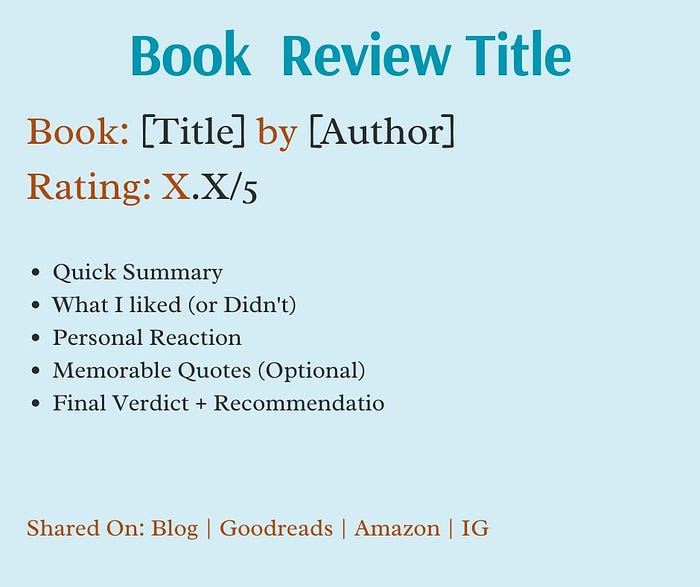
🟩 1. Start with a Quick Summary (No Spoilers)
Begin by briefly explaining:
What the book is about
The setting and main theme
Who the main character(s) are
🧠 Keep it short — 3 to 5 sentences max. The goal is to give readers context, not retell the entire story.
— –
🟩 2. Share What You Liked (or Didn’t)
Now comes your opinion.
Talk about things like:
Writing style (Is it poetic, simple, dense?)
Characters (Were they realistic? Relatable?)
Pacing (Was it a page-turner or a slow burn?)
Plot (Was it predictable or full of surprises?)
Themes (Did it make you think or feel something?)
🎯 Be specific. Saying “I loved the characters” is good.
Saying “I loved how the main character’s moral conflict deepened as the story progressed” is better.
— –
🟩 3. Add a Personal Touch
What was your personal reaction?
Did the book stay with you after reading?
Was there a quote or chapter that hit hard?
Did it remind you of something in real life?
Readers love authenticity.
Don’t be afraid to show emotion or share your experience.
— –
🟩 4. Use Quotes or Examples (Optional)
If a certain quote stood out, include it!
Just make sure it’s spoiler-free or clearly marked.
This adds depth and credibility to your review.
— –
🟩 5. Give a Final Verdict
Wrap up with:
A star rating (optional)
A short summary of your overall thoughts
Who you’d recommend this book to (or not)
Example: “If you enjoy slow-burn thrillers with emotional depth, this book is for you.”
✅ Dos and Don’ts of Book Reviewing
A book review is your space to express your opinion — but a little structure and etiquette go a long way in making your review more valuable (and readable).
Here’s what to do — and what to avoid.
— –
✅ Dos
✅ 1. Be Honest
Give your real opinion — whether it’s praise or criticism.
Honesty builds trust with your readers.
✅ 2. Explain Why
Don’t just say “I didn’t like the book.”
Say why — was it the pacing? Characters? Writing style?
✅ 3. Keep It Clear and Structured
Use short paragraphs, bullet points, or subheadings.
This improves readability, especially on mobile.
✅ 4. Consider the Book’s Audience
If the book isn’t for you, that’s okay — but acknowledge who might enjoy it.
Example: “While I found it slow, fans of historical fiction will likely appreciate the rich detail.”
✅ 5. Use Your Own Voice
Don’t try to sound overly academic (unless your audience wants that).
A natural, conversational tone often connects better.
— –
❌ Don’ts
❌ 1. Don’t Spoil Major Plot Points
Avoid giving away twists or endings unless clearly marked as a spoiler.
If you must include them, add a warning.
❌ 2. Don’t Attack the Author
Critique the book, not the person behind it.
Stay respectful, even if you didn’t enjoy the read.
❌ 3. Don’t Just Summarize
A review isn’t a book report.
Focus on insights, not just what happened.
❌ 4. Don’t Fake Positivity
If you didn’t like a popular book, it’s okay to say so — just be fair and explain your reasoning.
❌ 5. Don’t Use Generic Statements
Avoid phrases like “It was good” or “I liked it” without backing them up.
Specificity makes your review more helpful and credible.
✍️ Book Review Example
📖 Book: The Alchemist by Paulo Coelho
⭐ Rating: 4.5/5
— –
🟩 1. Quick Summary
The Alchemist follows Santiago, a young shepherd from Spain, who dreams of finding treasure near the Egyptian pyramids. His journey becomes more than just physical — it turns into a spiritual quest to discover his true purpose.
— –
🟩 2. What I Liked
The writing is simple yet poetic. Coelho’s language makes the story feel like a timeless fable.
Santiago’s journey is full of symbolism — from personal legends to omens — and it made me reflect on my own dreams and choices.
I especially loved the character of the alchemist and his philosophical conversations with Santiago. They weren’t preachy but felt natural and powerful.
— –
This book hit me at the right time. It reminded me to trust the journey, even when the destination isn’t clear.
Some parts felt repetitive, but I still found myself underlining quotes and pausing to reflect.
— –
🟩 4. Memorable Quote
> “When you want something, all the universe conspires in helping you to achieve it.”
Simple, but unforgettable.
— –
🟩 5. Final Verdict
The Alchemist is perfect for anyone feeling lost, stuck, or in need of inspiration.
It’s not an action-packed story, but if you enjoy books with deeper meaning and soul-searching themes, this one is worth reading.
🌐 Where to Share Your Book Reviews
Once you’ve written a thoughtful review, don’t let it sit idle.
Sharing it in the right places can:
Help other readers
Build your credibility
Attract engagement or even book collaborations
Here are the best platforms to share your book reviews:
— –
📚 1. Goodreads
The world’s largest community of readers.
You can rate, review, and create reading lists.
Reviews here often show up in Google search results.
🔗 Tip: Always link your blog (if you have one) in your Goodreads bio.
— –
🛒 2. Amazon
If the book is listed on Amazon, you can review it there — even if you didn’t buy it.
Helps indie authors a lot, especially for Kindle books.
Short, honest reviews (even 2–3 lines) make a difference.
— –
🌐 3. Your Own Blog or Website
Ideal for long-form, personal reviews.
Helps build organic traffic if SEO-optimized.
You control the design, voice, and visibility.
> ✅ Bonus: Link your reviews internally (e.g., “Check my review of XYZ if you liked this one”).
— –
📝 4. Medium
A great space for essay-style book reviews.
Tag the book’s genre (like #fiction, #memoir) for visibility.
You can also join writing publications that accept book content.
— –
📷 5. Instagram (Bookstagram)
Share a short version of your review with an aesthetic photo.
Use hashtags like #bookreview #booklover #amreading
Works best with a consistent theme and engagement.
— –
🎥 6. YouTube or BookTok
If you’re comfortable on camera, try short video reviews.
Even 60–90 seconds can work well.
Mention key takeaways, vibe, and who should read the book.
— –
💬 7. Reddit & Facebook Groups
Subreddits like r/books, r/selfpublish, r/BookRecommendations
Niche FB groups (e.g., Indian Book Bloggers, YA Fiction Readers)
Add value with your review, and avoid sounding promotional
— –
🔄 Pro Tip: Cross-Post Smartly
One review = many formats:
Full version on blog
Short version on Goodreads + Amazon
Visual quote on Instagram
Quick thoughts on Twitter or Threads
This boosts visibility without extra effort.
🌟 Bonus Tips for Book Bloggers
If you’re building a blog (or thinking about it), here are a few ways to make your book reviews stand out — and attract more readers.
— –
💡 1. Use SEO-Friendly Titles
Instead of just “Review: [Book Name],” try:
“The Alchemist by Paulo Coelho — Book Review + Life Lessons”
“5 Things I Loved (and Didn’t) About ‘Atomic Habits’”
This helps your reviews show up on Google.
— –
📸 2. Add Visual Elements
Include the book cover, author photo, or quote graphics.
Break long posts with headers, bullet points, and bold text.
Make it skimmable — many readers scroll before they read.
— –
📎 3. Link to Related Content
Create internal links:
“If you liked this, check my review of [related book].”
“Read: How to Publish Your First Book in India”
This keeps readers on your site longer (great for SEO!).
— –
🤝 4. Collaborate With Authors & Publishers
Reach out to indie authors for ARC (Advance Review Copies)
Join book blog tours
Tag authors on social media when posting your review
— –
📧 5. Build a Reader’s Email List
Offer a freebie (like a reading tracker or quote pack) in exchange for emails.
Then send updates when you post new reviews.
— –
📋 Book Review Checklist (Text Version)
Book Review Checklist:
✅ Read actively and take notes
✅ Identify key themes or standout moments
✅ Write a short, spoiler-free summary
✅ Share what you liked/disliked
✅ Include at least one personal reaction
✅ Use quotes (optional but powerful)
✅ Recommend the book to a specific audience
✅ Add a clear final verdict or rating
✅ Proofread before publishing
✅ Share your review across platforms
🧱 Book Review Framework (Visual Layout — Text Format)
> Writing a book review isn’t just about sharing your opinion — it’s about joining a larger community of readers and writers. Whether you’re reviewing your favorite sci-fi epic or a debut indie novel, your voice matters. So grab the free template, start writing, and let your inner critic shine!